Using watercolors ( part 2)

I AM FINALLY BACK!!!! i know you don’t really care…but whatever. Right now, i had just realized that I haven’t done a ” Using Watercolors” part two one. So here it is…

Paper

I should have mentioned this earlier before. When using watercolors, you should have paper that is thick enough to hold the water. If you are using printer paper or regular paper… you got the wrong paper. Watercolor paper is very special because it is the only paper( I know) that can hold enough water for a watercolor painting. If you use regular paper, the paper is going to mostly likely, start ripping apart or creating a hole. Even though it is a little pricey ( by little I meant a lot) it is more worth it than having your artwork ruined.

Brushes

When painting, it is most likely that you are going to use a brush. A simple brush could make a huge difference on how you paint and how it is going to look like. When buying a new brush, make sure to check the “snap” of a brush. A “snap” is how easily the bristles of a brush flicks. If it has a weak snap, the painting would have a more soft color and feeling to it. This brush can be used for a broad background or maybe for your first layer of paint. A strong snap on the other hand, can make your painting stand out more and make it have more contrast. Unlike the weak snap brush, this one can be used for details and more complicated backgrounds.

Other Forms of Watercolor

Watercolor can come in many different forms like ink, tubes, pans, and pencils. In my opinion, I prefer pans because it is more comfortable to use and it doesn’t waste that much paint. With watercolor inks, the way you paint can be different from the rest of the other forms of watercolor. It is much more loose to work with and a bit more pricey. Tubes on the other hand, can work as well as pans if you do not add a little or more water to it. Tubes I think, are a bit of a waste considering if you put too much of the paint in your pallet. Pans are very efficient if you are traveling. However, they can crack if you leave the lid open for too long. The cracks can result crumbs of paint in the pan, and it can disturb you while you paint. Finally, we have the pencils. On the bright side, watercolor pencils are very smooth and can be used without water. But on the not so bright side, the colors tend to look much paler then the other forms.

That is it for this page!! I hope this help you with you artworks and can consider buying brushes or paints with more consideration.😊
Art Tips for You to Know

In this page, I am going to be sharing with you my top 4 art tips!! Let’s get started.

  1. Editing your reference photo. When you are having trouble seeing or understanding the value or color of your photo, try editing it to make the colors stand out. Maybe add some more brightness or slightly change the contrast. If you have trouble seeing the value, edit it to greyscale.
  2. Take breaks. When doing your artwork, you want to take frequent breaks. The reason why is because you do not want to be too focused on the painting , and you have to be able to identify the important colors, value, etc. Try leaving it for a couple of hours or even several days. When you finally realize that you need to finish it, continue making that piece of artwork.
  3. Contrast. Going back to the first tip, using greyscale to identify the contrast really helps. By using greyscale, you can see the certain spots that need more or less contrast.
  4. Study the artworks of your favorite artist. Instead of comparing yourself to that person, study how they do their artwork! Try to find out their tricks and techniques for making their artwork, and if they give advice, follow it. Do not look down on yourself and get inspired by them.

You have made it to the end of this page! If you have more tips to share comment it down below! Thank you for reading and stay in touch for the next one. BAII!!!

How to Improve Your Art

When I was a kid, I used to ask myself… how do people make such good art?! Then, I noticed that they never started as a very good artists. They just had time and practice to make such great artwork. So today, I will be showing you how to improve your artwork.

  1. Try to find time to get a drawing or painting done. It does not mean you have to practice everyday( at least try ). If you have spare time after you do your work or other important stuff, then try to make a piece of artwork.
  2. Know how an object moves, interact, formal position. By knowing these things, you will have a better understanding of how to draw the object correctly.
  3. Try recreating your old drawings into one that you can draw today. This tip always helps me improve my art. By seeing how much you have improved and how much you don’t, you can see what spots you need to work and the ones you don’t have to work on. Try recreating the same drawing/painting every year.

Thank you for reading!! I hope these tips help you improve your artwork and remember… practice makes perfect. BAII🤗🤗!!!

Using Watercolors (part 1)

Using watercolors can be tricky. You have to have patience, and act quickly at the same time. This can be tricky for those of you who are impatient, but the the result of your patience are amazing!!! In this page, I am going to show the basics of doing watercolor.

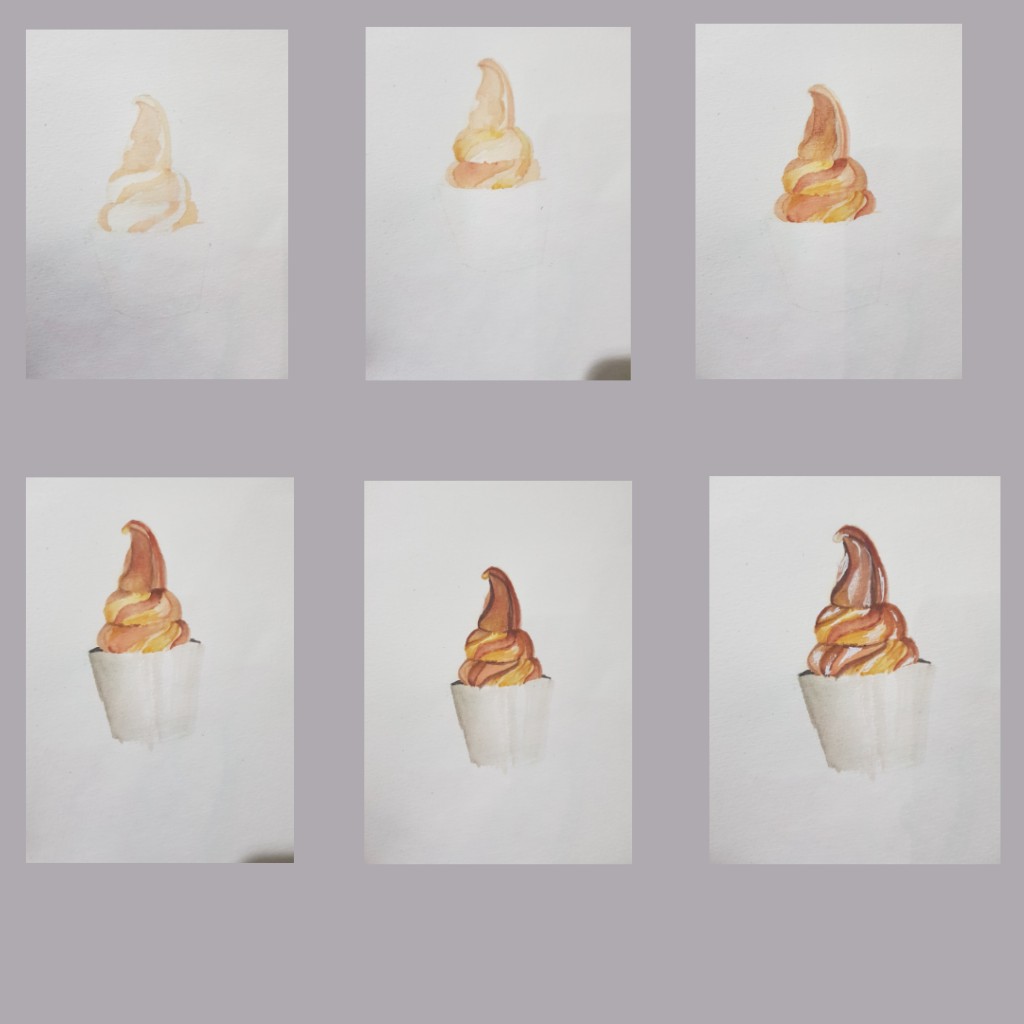
1.Starting of, you would want to put your base color. The base color can’t be too dark or else the other colors wouldn’t stand out, so it should be as light as possible. The base color would have to cover an the object based on the object’s color. However, when laying down the base color, you would still want to have it visible at the end result of your painting.

2. Next, you can start by adding the lightest color and filling it in with the highlight of the photo you want to paint. Also, add some details to it when the highlight is already applied. When I am watercoloring I start to paint from the top to the bottom, you will see why in the next step.

3. Waiting for the paint on the bottom to dry, start putting in the darker colors on the top. Don’t let it be too dark it else the highlights won’t stand out as much. From there, you can work your way to the bottom.

4. When the dark and light colors are done, try to add in some more details to make the painting stand out.

5. When you still don’t feel like your painting is dynamic enough, use a dry on wet technique( we are going to talk about techniques in part 2) and simply add a bit more color on the spots that don’t stand out in the painting. Use a slightly darker shade to do this.

6. Lastly, add in more highlights by using a white pen or correction pen to do some highlighting. * Tip: If you want to make a color look more whiter, simply put down the ink of the white/correction pen on the paper and mix it with the color you wanted. This way, the lighter color will look more opaque.

Right here are the examples of the steps( from left to right)

Thank you for taking the time to read this. I hope this helps you with your watercolor and learn some ways maybe you don’t know about it. Stay tuned for part 2 of this page. BAII!!!

5 Hacks for Broke Artist

In this page, I will be sharing art hacks for people who cannot afford such expensive art supplies, like me. These are the art hacks I personally use a bunch of times and they are very effective. If you are a broke artist and have some hacks, comment it down below!

  1. Making your own tortillion . If you don’t know what a tortillion is, it is a blending tool used for graphite or pencil. Tortillions are very pricey and sometimes, it is very hard to find. What I do ,usually, is I fold simple piece of paper about 5-6 times and… start blending!!
  2. Erasing watercolors. When using watercolors sometimes, you may find yourself using the wrong color or put some paint in the wrong spot. I have a simple solution for you. Use a sponge to quickly erase that spot or color. When doing this though, you have to act quick and erase it when the paper is wet. If you don’t have a wet surface, the paint will dry out and you won’t be able to erase it.
  3. A substitution for artist tape . When searching for artist tape, I don’t know if this is for you guys ,but I always saw them as a very expensive object for tape. What I do is I buy masking tape. Masking tape works the same way but is very sticky. That is why before using it, make sure that you stick it on some fibers to make it less sticky. If you prefer not to do that, you can take your hairdryer and start blowing the masking tape with it.
  4. A substution for white pens. White pens are usually for highlights and white details. They can be used in any type of media. However, when you don’t have a white pen, you can use a correction pen. A correction pen works as well or even better than a white pen( and even cheaper).
  5. Using the blue tac. A blue tac can replace the use of a kneaded eraser. If you don’t know what a needed eraser is, it is a certain type of eraser that is meant to be for highlights and details. You can knead it to have a sharp edge for the details and it could be for erasing guides, too. A blue tac works as well and it is half the price as the kneaded eraser.

Thank you for reading this page!! I hope this helps you broke artists to realize that you don’t need expensive supplies to make good art🤗😊.

Getting Started with Colored Pencils

When using colored pencils, people tend to make common mistakes(including me) like putting a layer of color incorrectly. In this page, I will be showing you tips and common colored pencil mistakes.

When I was a kid, I used to color the whole object the lightest color ,and then add the shadows in because it made me look so proffessional. On top of that, I would do so many mistakes that sometimes, I cringe just looking back at my old drawings and colorings. Now, looking back at my old days, I feel humiliated. That is why I want to tell you viewers to stop doing what I did as a kid and follow these simple rules:

  1. Start from the darkest to lightest shade/color. By doing this, the darkest shade won’t look so dark and it won’t overpower the light shade. Usually, the darkest shade for shadows and the lightest shade is for the highlights.
  2. Do not press so hard when using colored pencils. If you do that, you won’t be able to layer as well and it wouldn’t be able to show you the value of the piece of art that you have made.
  3. When you are drawing from a reference photo, it is better to put it on greyscale ( basically add a black and white filter). This way, you can see the value of the photo and not get distracted by the colors in it.
  4. This tip helps me a lot in coloring and that is, if you want to add more contrast to your coloring, take the middle shade and start shading in the darkish spots with it and some of the light spots lightly.
  5. When you want to make your coloring more dynamic, don’t try to be simple and try to add in more colors!! This usually is a problem in an object that only has one color. Try to use 3 to 4 different shades of the same color. You will be surprised at the result.

That is it for this page!!! Hopefully this highlights what you need to know for coloring and stay tuned for the next page!! BAIII!!!!🤗

Drawing Guides

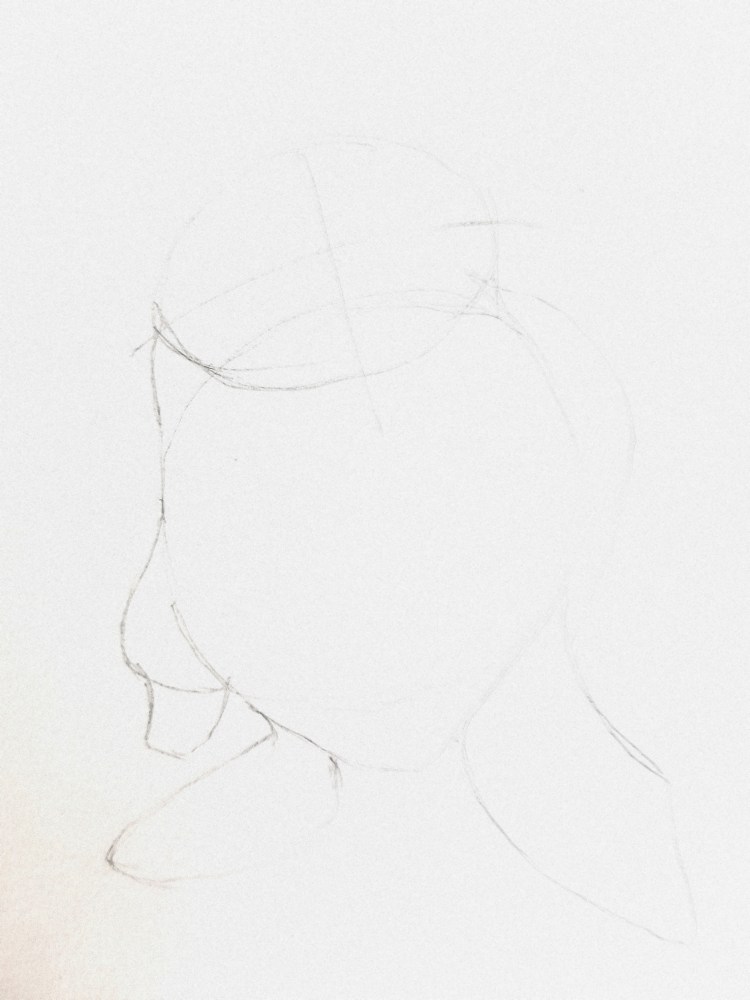
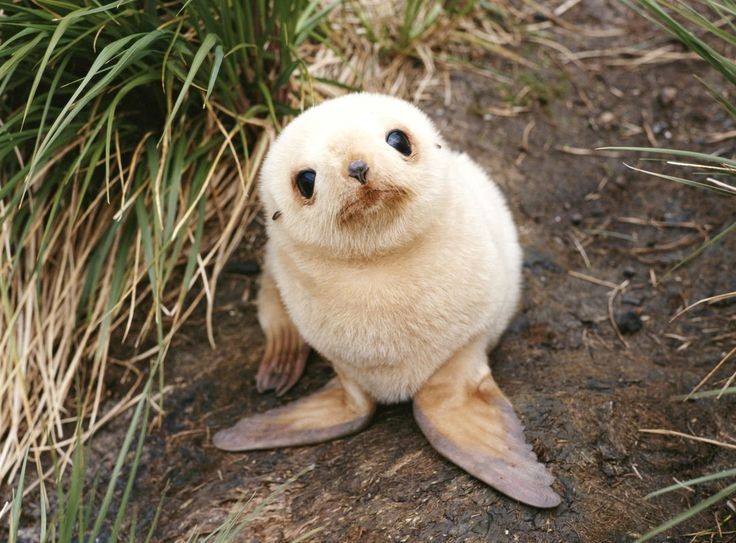
Have you ever wondered why is it…when you draw animals or people that they always look like they are kind of out of shape? It’s maybe because you haven’t drawn guides. By using guides, you can make your drawing more precice and accurate. Let’s take a look at an example:

So cute!!!

When drawing guides, you want to take some of your knowledge about shapes and add it to the picture. What shapes do you see in that seal? Probably an oval for its head, a big circle for its body, and other things. As you are drawing the guide, make sure that you don’t press your pencil onto the paper too hard.

I just realized I hadn’t drew the guide for the eyes….so sorry. Please do draw them… they are very important.

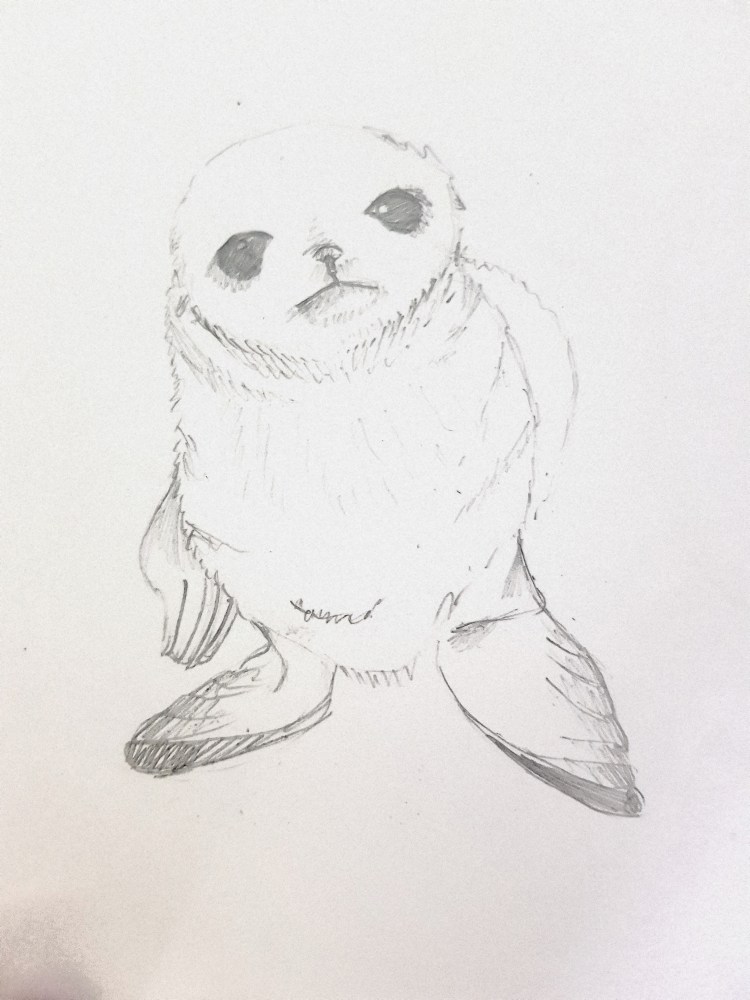
From then on, you could start slightly erasing the guide. Don’t erase it too much or else you won’t be able to see the guide clearly. Then… you add the details!!!

TA DAAA

Remember to always use a reference photo!! A reference photo is the photo of what you want to draw, like the seal. Without it, this drawing will look drastically different. Even if you have great memory(unlike me) you always have to use a reference photo. It is easier to see what you are drawing rather than remembering what you want to draw.

Thank you for reading this page😊😊!!! Stay tuned for my next post and I hope that with this method, you are able to create beautiful art!!🎨

Mistakes in Watercolors(+intro…kinda)

When using watercolors, people often forget about the important things about it like putting details on a wet layer of paint, accidentally mixing paints that you don’t want to mix,etc. In this page, I will show you the most important mistakes( to me ) in watercolor and how we should avoid them.

Transparency

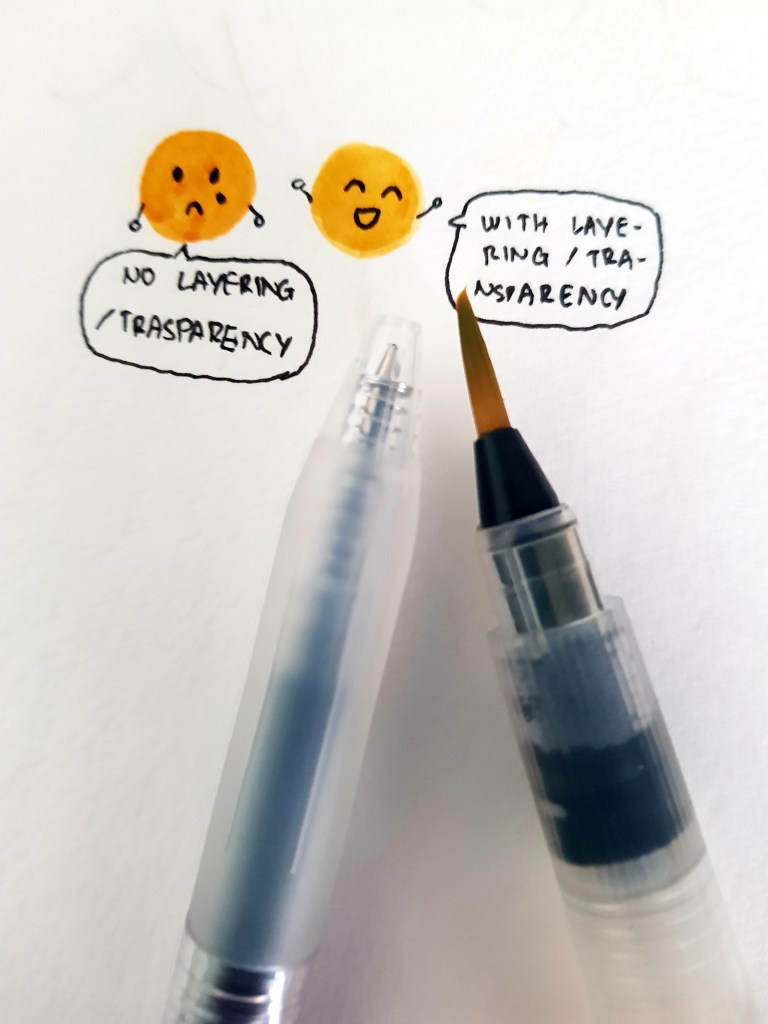
In watercolor, transparency is a big thing because watercolor is a transparent media. People who are new to watercolors often don’t know about this fact. Since it is a transparent media, you will have to layer often to get a nice layer of paint, often on the big areas. With layering, you can avoid dark spots( spots that have to much paint on it) and make your painting more clear.

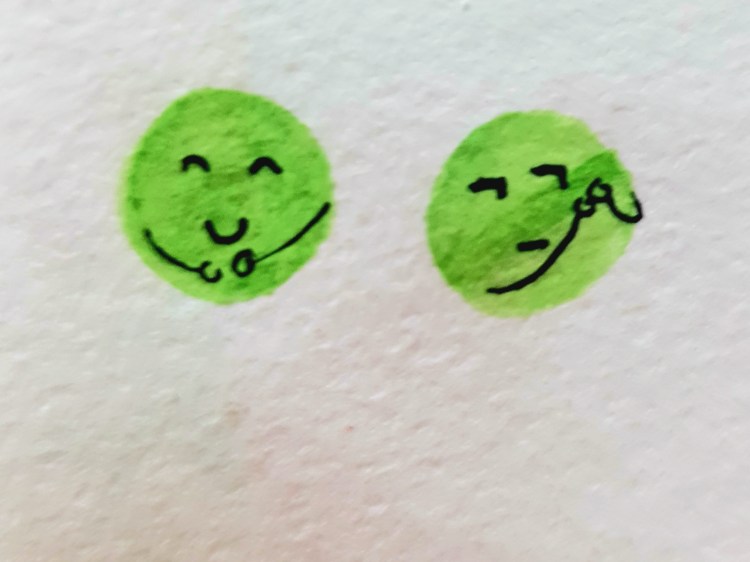
You can see that there are dark spots on the sad face compared to the happy face, and the happy face looks more clear.

Blending and keeping it clean

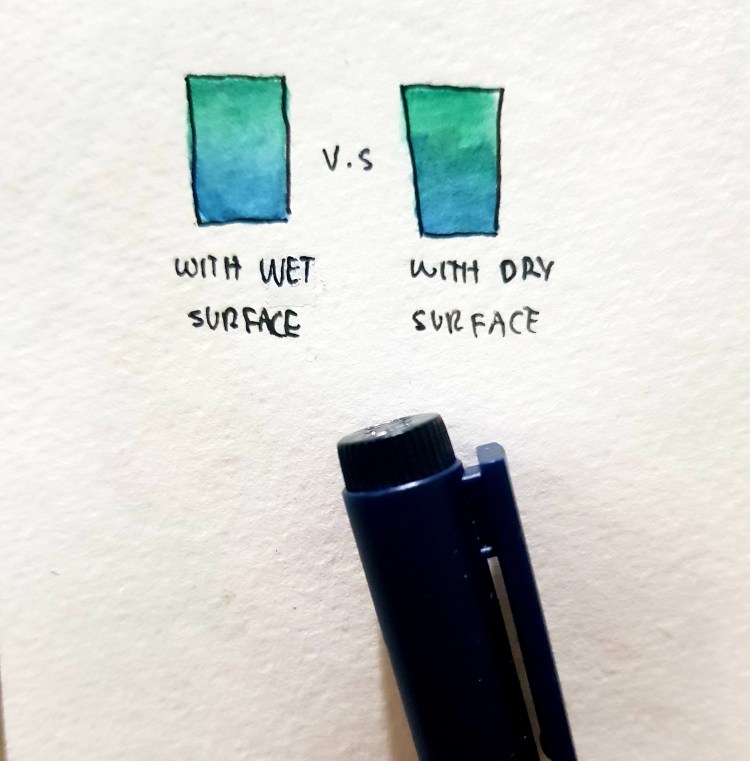
When blending watercolors, you would have to act really fast and add more of those colors you want to blend to…blend. The reason why is because it’s watercolor and you don’t want the water to dry before you start blending.

Notice that the right box isn’t as neatly blended as the right box because of a dry surface. (To be honest it still looks good though)

What I mean by keeping it clean was that in watercolor, you don’t want to make the brush strokes visible. To be honest, it is one of the things in watercolor that I struggle the most. It basically follows the same rule as blending: always have a wet surface. If you don’t have a wet surface, you can say hello to those disturbing brush strokes again.

The happy ball looks very happy because he is brush stroke free. Unlike the happy ball, the ball with a scar(brush stroke) on his face tends to hide himself from the world and chooses not to talk to people.

COLOR BLEEDING

This is a very common mistake you may find when using watercolor. When painting with watercolor, you have to have patience. Color bleeding is when you paint an area that is next to a wet one and they start mixing into each other. Try to paint another area before going back to the area that was wet before. This way, you can save time and work on other areas instead of waiting for a long time

.

That is it for this page!!! Thank you for reading it and hope it can help you with your next watercolor painting!!😊. I apologize for the bad pictures… they were taken from my phone😅.

The Real Primary Colors…

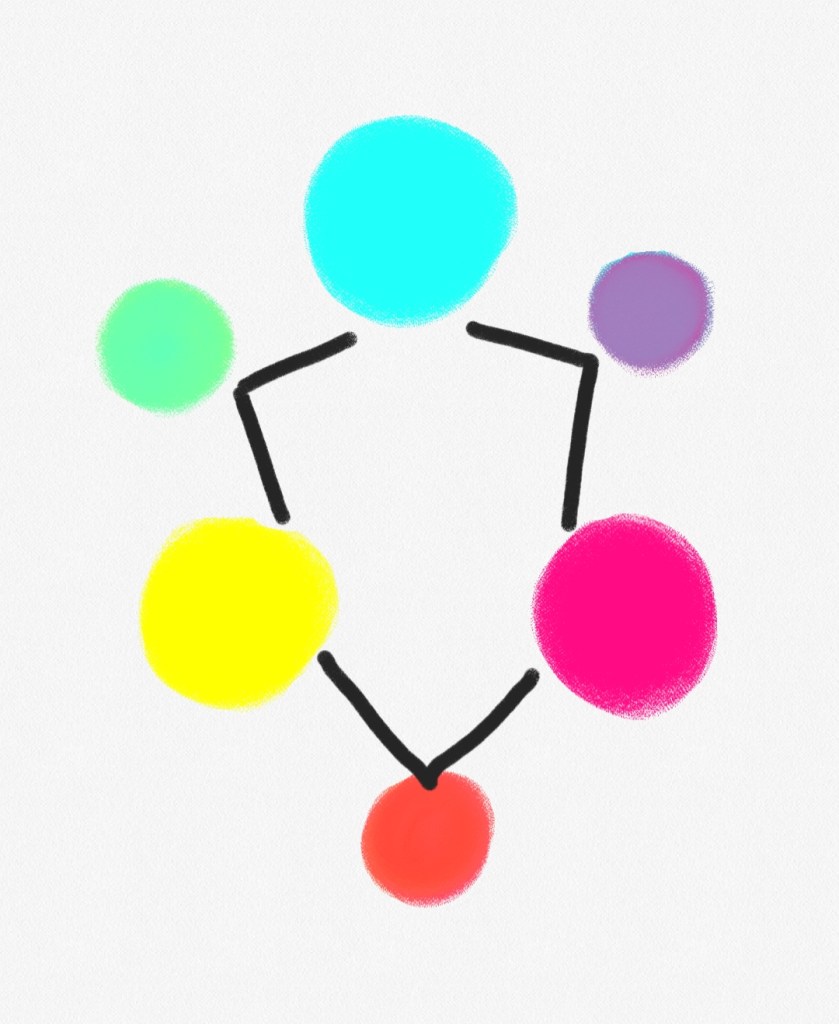
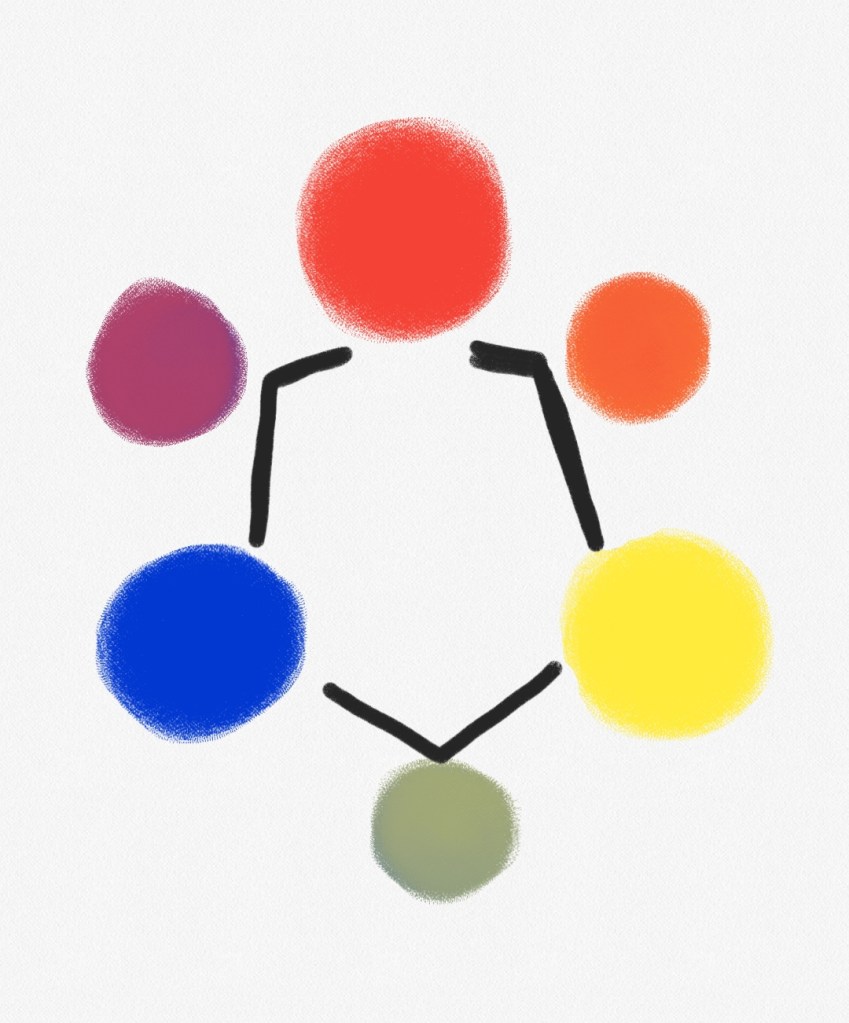
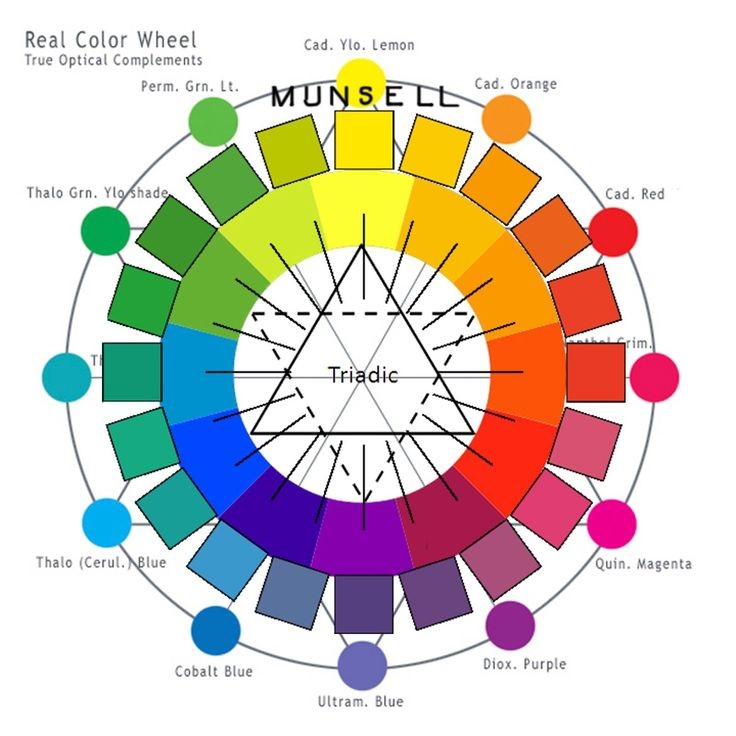
When you had art class as a kid, you probably already know the primary colors: red, blue, and yellow. Of course, these colors we all know are able to mix to have a secondary color which are purple, green, and orange. Now, what if I told you right now that those are not the real primary colors( dun dun duunnn). The real primary colors are yellow, magenta, and cyan. These are the colors in the Munsell color wheel. That is why they use printers use the CMYK because they don’t want their colors in the printing to be inaccurate . Let me show you an example…

As you can see, red is a secondary color. It does not belong into the primary colors. Have you ever wondered why you have such a muddy color when you mix the colors such as red and blue or blue and yellow? It’s probably because you have using the wrong colors. When you mix a secondary color with a primary color, the result would look really dark and muddy like this…

Take time to compare the first picture and the second picture. When mixing the blue and yellow, you can see that the green is very muddy looking and it is not very vibrant. Now see the green in the second picture and the one in the first picture. There is a drastic difference in that one color itself. Mixing the magenta and yellow in the first picture you get red, almost the same one in the second picture. Then mix cyan and magenta, the purple is very bright and probably the purple you would expect to come when you mix red and blue.

That is it for my first blog!!! Hope this blog is useful your next artwork whether you are oil painting, digital drawing, etc. We did not get into the the Munsell color wheel that deeply because it is mostly based on science. Here is the whole Munsell and Triadic color wheel if you want to see the more of the colors in the wheel…

Tip: when you want to have a darker color, do not mix it with black. Mix it with the color opposite of the wheel.

Delaram Art & Design

Custom Art | Interior Design | Art Instructor | Logo Design

SHINE OF A LUCID BEING

Astral Lucid Music - Philosophy On Life, The Universe And Everything...

Lluís Bussé

Barcelona's Multiverse | Art | Culture | Science

MM Fine Art Studio

My Creative Process

Endless Roaming

Heading out of Australia to escape this Aussie winter. First stop Japan, then UK/Ireland and if work doesn't call me back, onto Chicago. I will make it up as I go along

LIfeTech with NikitaSainju

Blog writer, travel writer, journal writer, cooking, nature lover, book lover..

Now The Mysterious Blabberer?

Only ‘The Mysterious Blogger’ on a Short Leash Knows for Sure!

Design a site like this with WordPress.com
Get started